Bank Transfer vs Money Transfer App: Which Costs Less?
General information, not advice. This guide explains how things usually work. Fees, rules and products change and depend on your country and situation, so check the provider's or authority's own page before you act. See our disclaimer.
Some links may be affiliate links. They never change what we recommend. How we make money.
You need to send money to another country and have two obvious choices: do it through your bank, which you already trust, or use a money transfer app that promises lower fees and faster delivery. The apps usually advertise a low price, the bank shows a form with a fee and an exchange rate, and it is not obvious which will leave more money in your recipient’s account.
This guide compares the two on cost, exchange rate, speed, limits, safety and convenience, backs the comparison with World Bank data, walks through a worked example and shows when each option wins. For a wider look at every way of moving money, see our guide to the cheapest ways to send money abroad.
The short answer
For most small and medium transfers, a regulated money transfer app that uses the mid-market rate and shows its fee separately costs less than a bank transfer, and is often faster and easier to track. A bank can still be the right choice for very large amounts, bank-to-bank requirements or routes that apps do not cover, especially if your bank gives you a good exchange rate. The only reliable way to know is to compare how much the recipient actually receives.
What the data says
The World Bank tracks the cost of sending 200 US dollars across hundreds of country pairs in its Remittance Prices Worldwide database. Its latest figures point in the same direction:
- Banks are the most expensive channel. In the World Bank’s issue for March 2025, banks remained the most expensive type of provider, with an average cost of 14.55%. A summary of the September 2025 issue puts the bank average at nearly 15%.
- Digital channels are much cheaper. The World Bank’s digital remittances index stood at 4.85% in early 2025, and a summary of the later issue puts it at about 4.6%, against roughly 7.3% for non-digital services. Digital-only money transfer operators averaged around 3.5%.
- The overall average has barely moved. The global average cost of sending 200 dollars was about 6.5% in 2025, more than double the G20 target of bringing it down to 3% by 2030, while sending 500 dollars averaged about 4.3%.
- Mobile money is the cheapest instrument. The World Bank reports it averaging about 3.6% in early 2025.
How to read these numbers
Be careful with them:
- They are averages for small remittances (200 dollars), mostly sent by individuals to family. A freelancer sending thousands will see different costs.
- Averages hide huge differences between providers and between country pairs. The cheapest qualifying services are far below the average.
- Banks in the data include in-person and online transfers, and costs depend on the bank.
The message is not “banks are always expensive”. It is that, on average, banks charge several times more than digital providers for small international transfers, and you should check before you assume otherwise.
Why banks often cost more
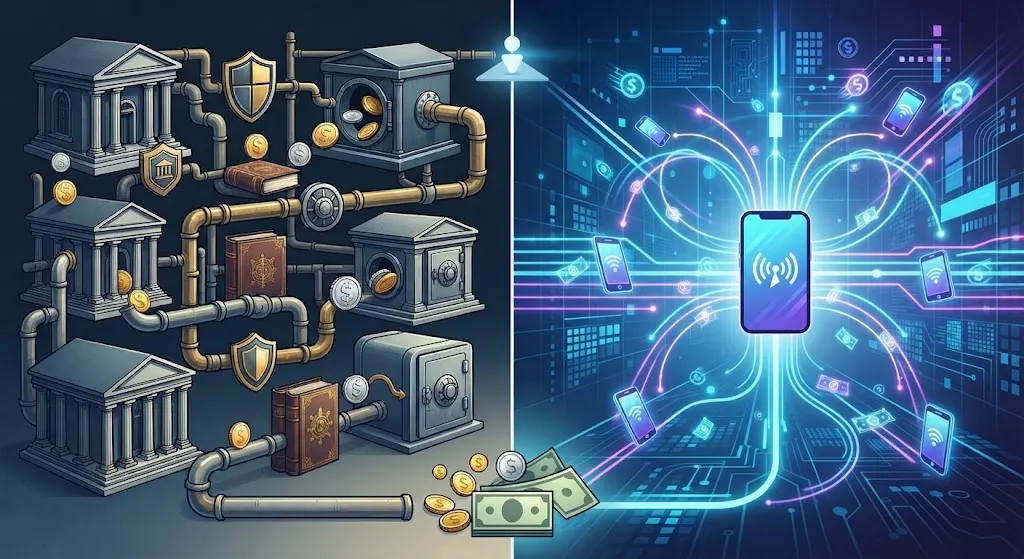
Most bank international transfers still travel through the correspondent banking network, with several banks in the chain, and each can take a fee or add a margin. To see how that works, read how bank wires work. On top of the visible fees, banks usually convert currency at their own retail rate, which includes a markup over the real rate. That hidden exchange rate margin is often the largest cost.
Why apps are often cheaper
Many digital providers hold prefunded accounts in both the sending and the receiving country, so they can match payments in opposite directions locally instead of sending each one through a chain of banks. One industry commentary notes that digital-first services often cost about 2% to 5%, against 4% to 18% for traditional bank wires, though ranges like these depend on the source and the route. Apps also tend to show fees upfront and use the mid-market rate with a visible fee.
Comparison at a glance
| Bank transfer | Money transfer app | |
|---|---|---|
| Typical cost | Often higher: fees plus a margin on the exchange rate, and possible intermediary fees | Often lower and shown upfront: a visible fee and a rate close to the market rate |
| Exchange rate | Usually the bank’s own retail rate | Often the mid-market rate plus a fee, but check |
| Speed | Typically one to five business days. See how long international payments take | Often minutes to a couple of days, depending on the route |
| Tracking | Reference or UETR from the bank | Usually live tracking in the app |
| Limits | Often high | Often lower per transfer or per period, with verification |
| Cash pickup | Rare | Available with some money transfer operators |
| Coverage | Almost everywhere | Limited to supported countries and currencies |
| Support | Branches and phone | App chat and email |
| Best for | Large amounts, bank-to-bank requirements, uncovered routes | Small and medium transfers, regular transfers, transparency |
Speed
Apps are often faster, but not always. A transfer can be delivered in minutes through a provider with local accounts at both ends, while a bank wire may take several days. The picture is mixed, though: non-digital services such as cash transfers can sometimes be faster than digital ones, because many digital transfers still depend on bank-to-bank infrastructure for the final step. Always check the estimated delivery time for your specific route.
A worked example (illustration only)
Imagine you want to send 2,000 US dollars to a recipient who will receive euros, with a mid-market rate of 1 USD = 0.90 EUR. At the perfect rate the recipient would get 1,800 EUR. The numbers below are made up to show how costs add up. They are not real quotes.
| Bank transfer | Money transfer app | |
|---|---|---|
| Visible fee | 30 USD | 0.6% = 12 USD |
| Exchange rate margin | 3% | 0% |
| Amount converted | 1,970 USD | 1,988 USD |
| Rate applied | 0.873 | 0.90 |
| Recipient gets | about 1,720 EUR | about 1,789 EUR |
| Total cost vs the perfect 1,800 EUR | about 80 EUR (4.5%) | about 11 EUR (0.6%) |
The bank’s fee looks small, but the rate margin is where most of the cost sits. Replace the numbers with real quotes to see your own result.
When a bank transfer is the better choice
- Very large amounts, where an app’s limits apply or where your bank offers a negotiated exchange rate. Always ask for the margin and compare.
- A bank-to-bank wire is required, for example for a property purchase, a legal payment or an official fee.
- The route or currency is not covered by apps, or the recipient is in a country where app services are limited.
- You have a bank account with favourable foreign exchange terms, such as a premium package or an account designed for international use.
- You need the formal record of a bank payment for compliance reasons.
- You prefer to deal with a branch, or your recipient is not comfortable with apps.
Even then, ask for the total cost and compare with at least one app.
When a money transfer app is the better choice
- Small and medium amounts, particularly if you send regularly.
- Transparency matters: you want to see the fee, the rate and the amount received before you confirm.
- You want faster delivery and live tracking.
- You send to a bank account in a country the app supports.
- You need cash pickup and the app offers it, although this is usually the most expensive delivery method.
- You want to hold several currencies and convert when it suits you. See multi-currency accounts.
Types of apps
“Money transfer app” covers very different services:
| Type | What it is | Typical cost level | Watch out for |
|---|---|---|---|
| Specialist transfer provider | Built for international transfers, with mid-market rate and visible fee | Low | Limits, verification and route coverage |
| Multi-currency account | An account with local details and conversion | Low for conversion, varies for receiving and withdrawing | Protection and availability by country |
| Money transfer operator with cash pickup | A large agent network | Often higher, especially for cash pickup and card payments | Rate markups and extra fees |
| Payment wallet | A wallet used for payments between users | Often the highest conversion fees | Fees can be several percent |
| Mobile money | Transfers between mobile wallets | Among the lowest in the World Bank data | Only in supported corridors |
Not every app is cheap, so check each one.
How to compare: step by step
- Find the mid-market rate for your currency pair, as your reference.
- Get quotes for the same amount from your bank and at least two apps.
- Compare how much the recipient receives, not the headline fee.
- Check the payment method, since paying by bank transfer is often cheaper than paying by card.
- Check the delivery time and limits for your route.
- Check who pays any intermediary fees and whether the recipient’s bank will charge.
- Calculate the total cost with our transfer fee calculator.
- Make a small test transfer first with a new provider.
Safety
Both banks and apps can be safe, but the protection works differently:
- Check that the provider is regulated in your country and find out which regulator oversees it.
- Understand how your money is protected while it is in transit or in an account. The rules for banks and for non-bank providers differ, as we explain in how your money is protected.
- Turn on two-factor authentication and alerts.
- Verify the recipient’s details before you send.
- Beware of scams, such as fake apps, fake support numbers and requests to send money urgently to someone you do not know.
- Do not leave large balances in an app account.
If something goes wrong
Both banks and apps can delay, hold or return a payment, for example because of incorrect details or compliance checks. Apps usually give you more visibility, but you should still know what to do. Read what to do when your transfer is delayed or blocked.
If you are receiving
If you are the one receiving money, ask the sender to use the cheapest option for both of you, and consider giving local account details in the sender’s currency. See the ways to receive payments from abroad for the options.
Common mistakes to avoid
- Assuming your bank is the cheapest because it is familiar.
- Assuming every app is cheap. Wallets and cash pickup can be expensive.
- Comparing only the fee and ignoring the exchange rate.
- Not comparing the amount the recipient receives.
- Paying by card when a bank transfer is cheaper.
- Ignoring limits and verification until the day you need to send.
- Using an unregulated service.
- Sending a large amount with a new provider without a test.
- Not keeping the confirmation and reference.
- Not checking the rate against the mid-market rate.
Frequently asked questions
Is a money transfer app cheaper than a bank?
Usually for small and medium transfers, especially when the app uses the mid-market rate and shows a clear fee. World Bank data show bank transfers as the most expensive channel on average, but individual quotes vary, so compare.
Is it safe to use a money transfer app?
Regulated apps are generally safe, but protection differs from a bank deposit. Check the regulator and how funds are safeguarded.
Which is faster, a bank or an app?
Apps are often faster, with transfers arriving in minutes to a couple of days, while bank wires typically take one to five business days. It depends on the route.
Why is my bank’s exchange rate worse?
Because banks usually add a margin to the mid-market rate and keep the difference.
Can I send large amounts with an app?
Often yes, but limits and verification apply. For very large amounts, compare with your bank and ask for a negotiated rate.
Do apps send money to bank accounts?
Many do, in supported countries. Some also offer cash pickup or mobile wallet delivery.
How do I compare providers fairly?
Use the same amount and currency, check the mid-market rate, and compare how much the recipient receives, including all fees.
Final thoughts
On average, apps cost much less than banks for small international transfers, but the best option depends on your amount, route and needs. Compare the amount the recipient receives, check limits and delivery time, make sure the provider is regulated and keep a bank option for the cases where it still makes sense. A few minutes of comparison can save a surprising amount, especially if you send money regularly.
This article is general information, not financial advice. Fees, rates and rules change and vary by provider, country and route. Information reviewed October 12, 2026.
Sources and further reading
Official pages and primary sources where you can check the rules, fees and rates discussed in this guide. They are updated by their publishers, so check them for the current figures before you decide.
- Remittance Prices Worldwide (World Bank)
- Money transfers: your rights (Consumer Financial Protection Bureau (US))
- Swift gpi: tracking cross-border payments (Swift)
- Payment services in the EU (PSD2) (European Commission)