Best Online Business Accounts for Freelancers Working Abroad
General information, not advice. This guide explains how things usually work. Fees, rules and products change and depend on your country and situation, so check the provider's or authority's own page before you act. See our disclaimer.
Some links may be affiliate links. They never change what we recommend. How we make money.
When you start earning as a freelancer, you can run everything through your personal bank account. It works at first, and then it stops working: invoices mix with groceries, taxes become a puzzle, a bank asks where a payment came from and you realise that personal accounts were never meant for business income.
A business account solves that, and for freelancers who work with clients in other countries, an online business account with multi-currency features can also save a lot in fees. But not every business account accepts freelancers, not every one works in every country and “business account” can mean very different things. This guide explains who needs one, what types exist, how to compare them, who can open one from abroad and how to set it up. If you are new to the multi-currency products behind many of them, start with our guide to multi-currency accounts.
The short answer
- If you earn regularly from freelancing, a separate account for business income is a good idea, and in some countries or under some providers’ terms, it is required.
- For freelancers with clients abroad, an online business account that lets you receive several currencies is usually cheaper and easier than a traditional business bank account.
- What you can open depends on your country of residence, your business status (sole trader, company) and the provider’s rules. Availability changes often, so check before you plan around any provider.
- Many freelancers use two accounts: an online multi-currency business account for international payments, and a local bank account for domestic payments and local obligations.
Do you need a business account?
Not always, but there are good reasons to have one:
- Clear finances. Business income and costs in one place make bookkeeping, invoices and tax returns much simpler.
- Terms of use. Many personal accounts restrict business use, and receiving business income in one can trigger reviews or closures. Read why personal accounts get closed.
- Professionalism. Clients often take a payment to a business-named account more seriously.
- Legal or tax requirements. In some countries, sole proprietors or companies must keep business money separate.
- Better features. Business accounts often offer invoicing, multiple users, higher limits and accounting integrations.
Check your country’s rules. In some places sole traders can legally use a personal account, and in others a business account is expected or required.
Types of business accounts
| Type | What it is | Typical strengths | Watch out for |
|---|---|---|---|
| Online multi-currency business account | Digital account to hold, receive and convert several currencies | Low international costs, local details in several currencies, fast opening | Not always a bank; protection differs; availability by country |
| Neobank business account | App-based bank account for businesses | Cards, integrations, fast onboarding | Plans and features change; eligibility rules vary |
| Traditional business bank account | Business account at a local or national bank | Full services, loans, deposit protection | Slower opening, paperwork, higher fees for international payments |
| Payout platform account | Receiving account built for marketplaces and agencies | Widely accepted for marketplace payouts | Withdrawal and conversion fees. See PayPal, Wise or Payoneer |
If you want to understand the technology behind the first type, read how a multi-currency account works.
What to compare
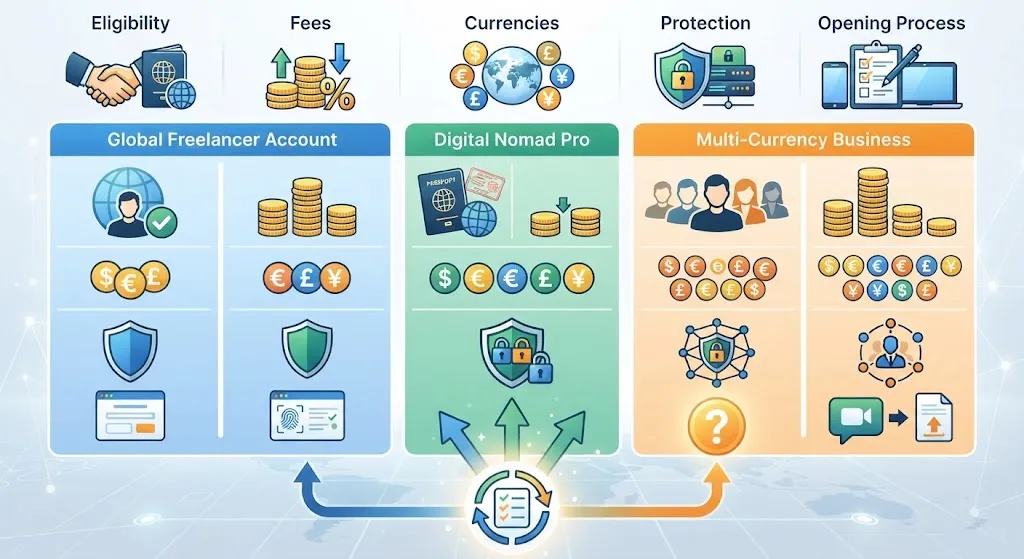
Look at the same points for every provider:
- Eligibility: does it accept freelancers and sole traders, or only registered companies?
- Countries: is it available where you live and where your business is registered?
- Local account details: in which currencies can you receive payments like a local?
- Fees: setup, monthly, receiving, sending, conversion and card fees.
- Exchange rate: whether it uses the mid-market rate and shows its fee separately.
- Protection: whether it is a bank or an e-money institution, and how funds are protected.
- Cards: physical and virtual cards, limits and ATM fees.
- Features: invoicing, payment links, accounting integrations, multiple users.
- Limits and verification: how fast you can open it and what limits apply.
- Support: access to help if a payment is held.
Providers you will see most often
The providers below are examples, not a ranking. Plans, prices and eligibility vary by country, and the sources I checked are mostly the providers’ own comparison pages or those of their competitors, so use this as a starting point and confirm everything on each provider’s current page.
Wise Business
Wise Business is a multi-currency business account that accepts sole traders and limited companies in the countries where it is available. According to its own pages for the UK, it has no monthly subscription, charges a one-time setup fee to unlock the advanced features (£50 in the UK, with a free basic version), receives domestic-style payments for free and shows transfer fees from about 0.33%. Other country pages list a different setup fee, for example about €45 in one 2026 review and $31 in a US comparison, and local account details in a different number of currencies (nine currencies with full local details in some comparisons, and more than 20 for receiving through different routes). You can hold 40+ currencies.
An independent 2026 review points out an important limit: as a sole account, it lacks credit options and statutory deposit protection, so many freelancers use it as a secondary account for international payments alongside a traditional business account.
Best for: freelancers paid regularly in foreign currencies.
Watch out for: the setup fee, protection that differs from a bank, and availability by country.
Revolut Business
Revolut Business is a business account with multi-currency features, cards and team tools, with paid plans that scale up. The details are less straightforward for freelancers:
- One comparison reports that Revolut used to accept freelancers and sole traders as a business type, but the freelancer plans were discontinued from 8 July 2024 and it requires a registered business with a physical presence in an eligible country. That comparison is published by a competitor, so confirm it on Revolut’s own page.
- Sources disagree on pricing: one comparison says there is no free business plan in the UK, with an entry plan from £10 per month, while another says that free plans with limits exist. Prices also differ by country.
- A US-focused comparison says its business accounts cannot send or receive international wire transfers and recommends international ACH instead.
Best for: registered companies that want cards and team features.
Watch out for: eligibility for sole traders, plan fees and international wire limits.
Airwallex
Airwallex is another option aimed at small businesses, startups and freelancers who need cross-border payments in several currencies. Its own comparison page lists a free plan and a paid plan with more tools, and says it is available to eligible businesses with tailored onboarding.
Best for: businesses that need cross-border payments with more tools.
Watch out for: eligibility and onboarding requirements.
Payoneer
Payoneer is built for people paid by marketplaces, agencies and international clients, with receiving accounts in several currencies. Fees vary by territory and route. Details are in our comparison of PayPal, Wise or Payoneer.
Local business banks
Local banks in your country of residence may offer business accounts for sole traders, sometimes free. Some European banks offer free business accounts for sole traders with limited free transactions, for example. These are often useful for domestic payments, taxes and local obligations, and may offer deposit protection, but they are usually less efficient for international payments.
Who can open one?
The type of provider and your situation decide your options:
- Sole trader or self-employed. Many online providers accept sole traders, but some require a registered company. Check what they call a business and what documents they need.
- Registered company. Almost all business accounts accept companies, but they may require the company to be registered in a supported country and, in some cases, to have a physical presence there. If you are considering this route, read whether you should register a company abroad as a freelancer.
- Non-resident. You may need to show where you live, where your business is registered and how you earn. See how to open a bank account as a non-resident.
- Restricted activities. Providers do not accept certain industries or activities, so check the list.
Documents you will need
Typical requirements for a freelancer or small business:
- Identity document for the owner.
- Proof of address.
- Tax identification number and, where relevant, VAT number.
- Business registration documents, or proof that you are self-employed, depending on the provider.
- Description of your business, clients and expected activity.
- Proof of income or source of funds, such as invoices and contracts.
- For companies: ownership details and, in some cases, details of directors and shareholders.
Protection
Business accounts have the same protection question as personal accounts: is the provider a bank with deposit insurance, or an e-money institution that safeguards your funds? Business customers are not always covered by deposit protection in the same way as individuals, and the rules differ by country. Check the provider’s statement, and read our guide to how your money is protected. A sensible approach is to keep operating cash in your business account and larger reserves in a regulated bank.
Bookkeeping and invoicing
A business account works best when it is part of a clean process:
- Pay yourself a regular amount from the business account to your personal account.
- Send each client a clear invoice that includes your payment details. See how to invoice an international client.
- Match every payment to an invoice.
- Choose accounting tools for freelancers that connect to your account and handle multiple currencies.
- Keep records of contracts, invoices and statements.
Taxes
A business account does not change your tax obligations, but it makes them easier to meet. You still owe tax where you are tax resident, and some countries have specific rules for sole traders and companies. If your situation involves several countries, consider an international tax adviser.
How to choose: a quick guide
| Your situation | A good starting point |
|---|---|
| Sole trader paid by clients in several currencies | An online multi-currency business account that accepts sole traders in your country |
| You operate through a registered company | A business account from a provider that supports your company’s country |
| You are paid mainly through marketplaces | A payout platform account, then move money to your main account |
| You need local services (loans, cheques, domestic payments) | A local business bank account, plus an online account for international payments |
| You live somewhere few providers serve | Start with the providers that serve your country, and consider a local bank |
| Large balances or low risk tolerance | A business account at a bank with deposit protection, and keep only operating cash online |
How to open one: step by step
- Decide your structure: personal sole trader, registered sole proprietorship or company.
- Check eligibility and availability for your country and business type.
- Prepare your documents, including business registration, tax numbers and proof of address.
- Compare total costs on the payments you actually make.
- Apply and complete verification, and be ready for follow-up questions.
- Request local account details for the currencies your clients use.
- Update your invoices and tell your clients the new details.
- Test with a small payment before your first large invoice.
- Open a backup account at a different provider.
Common mistakes to avoid
- Mixing personal and business money.
- Assuming any provider accepts freelancers. Eligibility changes.
- Choosing only on headline fees, without checking setup costs and exchange margins.
- Relying on a single provider.
- Keeping large balances in an account with no deposit insurance.
- Not telling the provider about changes in your business or residence.
- Using a business account for activities the provider does not allow.
- Not keeping invoices and contracts.
- Ignoring the setup fee when comparing.
- Waiting until you need it to open the account.
Frequently asked questions
Do freelancers need a business bank account?
Not always, but it is strongly recommended for keeping finances clear, and some countries or providers require it. Check your local rules.
Can I open a business account if I am a sole trader?
Often yes, but not with every provider. Some accept sole traders, others require a registered company.
What is the best business account for freelancers with international clients?
It depends on your country, your business type and the currencies you use. Look for local account details in your clients’ currencies, transparent exchange rates and clear eligibility.
Do I need a company to open one?
Not necessarily. Some providers accept sole traders and self-employed people, but others only open accounts for registered companies.
Are online business accounts safe?
They are usually regulated, but the type of protection differs from a bank deposit. Check whether the provider is a bank or an e-money institution.
Can I use my business account from another country?
Often yes, but it depends on where your business is registered and where you live. Check the provider’s country rules.
Should I keep my personal account?
Yes. Pay yourself from your business account to your personal account, and keep a separate account for everyday life.
Final thoughts
A good business account turns messy freelance finances into a simple system: clients pay into one place, costs are clear and you pay yourself a regular amount. Check eligibility before anything else, compare total costs rather than headline fees, keep operating cash in the account and larger savings in a bank with deposit protection, and always keep a backup. Plans and eligibility change often, so review your setup once a year.
This article is general information, not financial, tax or legal advice. Products, fees and rules change and vary by country. Information reviewed October 7, 2026.
Sources and further reading
Official pages and primary sources where you can check the rules, fees and rates discussed in this guide. They are updated by their publishers, so check them for the current figures before you decide.
- Recordkeeping for small businesses (IRS (US))
- Bank accounts in the EU, including the right to a basic account (Your Europe (European Union))
- Deposit guarantee schemes (European Commission)
- The FATF Recommendations on anti-money laundering (Financial Action Task Force)