Best Debit Cards for International Travel and Remote Work
General information, not advice. This guide explains how things usually work. Fees, rules and products change and depend on your country and situation, so check the provider's or authority's own page before you act. See our disclaimer.
Some links may be affiliate links. They never change what we recommend. How we make money.
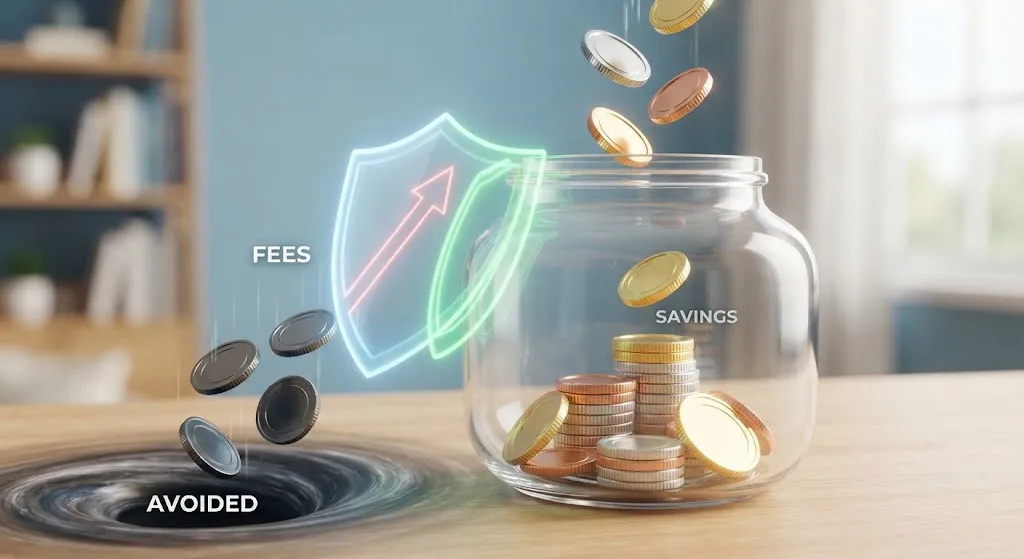
The wrong debit card can quietly cost you hundreds of dollars a year when you travel or live abroad: a fee for using it in another currency, a charge on every cash withdrawal, an exchange rate with a hidden markup and sometimes an extra markup at weekends. The right card does the opposite. It spends in the local currency at a fair rate, charges little or nothing at ATMs and still works when you need it most.
This guide explains what to look for in a debit card for international travel and remote work, the main types of cards, how two of the best-known options charge (based on their own fee pages), how to choose and how to use cards safely. If cash is a big part of your plans, read our guide on how to avoid ATM fees and bad exchange rates abroad too.
The short answer
For travel and remote work, look for a debit card that has no foreign transaction fee, a fair exchange rate with a visible fee, a generous free ATM allowance and no surprise markups, and pair it with a second card from a different provider as a backup. Cards linked to multi-currency accounts are often the cheapest for international use, while a traditional bank card can still be useful for local life.
What to compare
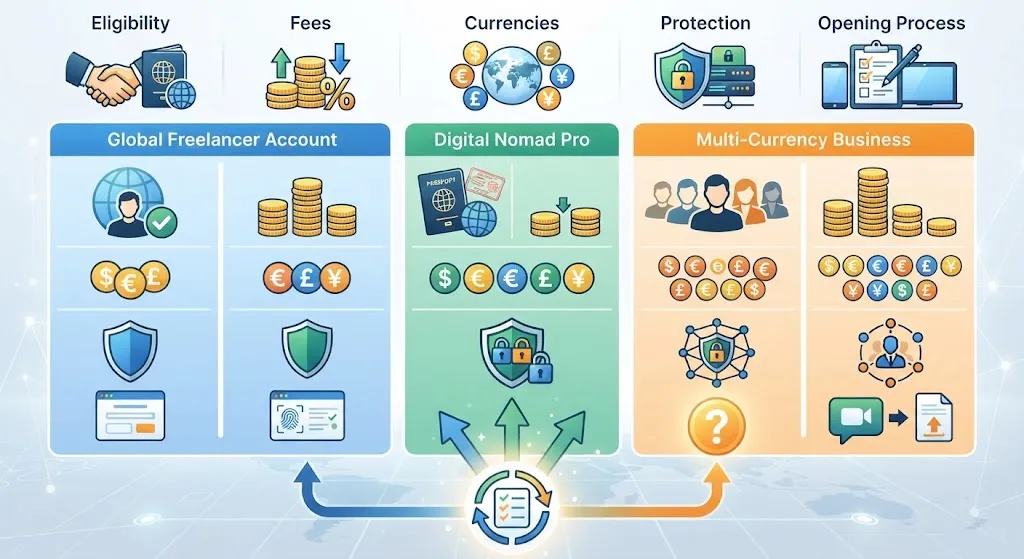
1. Fees for spending in other currencies
Check whether the card charges a foreign transaction fee and how it converts currency. Ideally the card uses the mid-market rate or something very close to it and shows any fee separately. See how exchange rate margins work to understand what to look for.
2. Currency conversion allowances and markups
Some cards give you a monthly allowance of conversions at the market rate, then charge a fee above it. Some add an extra markup at weekends, when currency markets are closed. These rules differ by plan and country.
3. ATM withdrawals
Look at the free monthly allowance (in amount, and sometimes in number of withdrawals), the fee after the allowance and whether the card reimburses the ATM operator’s own fee. Remember that the machine owner may charge its own fee on top. Our guide to ATM fees abroad explains the layers.
4. Card, replacement and delivery fees
Some cards are free, others charge a one-time fee to order the card, a replacement fee or delivery charges.
5. Limits
Check daily and monthly limits for spending and withdrawals, and for how much you can hold.
6. Acceptance
Most cards run on Visa or Mastercard networks and are accepted widely, but some merchants, such as car rental firms and hotels that take deposits, may be stricter with debit cards or prepaid cards. A second card helps.
7. Digital features
A digital card you can use immediately, mobile wallet support, instant notifications, card freezing and virtual cards for online payments all matter on the road.
8. Protection and security
Check how your balance is protected, what happens if you lose the card and what chargeback or dispute options you have. A card is only as safe as the account behind it. Read how your money is protected.
9. Availability in your country
Not every provider serves every country, and the card may differ depending on where you live. If you have just moved, see how to open a bank account as a non-resident.
10. Support
A lost card at night in another country is when support matters. Look for round-the-clock help in a language you understand.
Types of cards
| Type | What it is | Strengths | Watch out for |
|---|---|---|---|
| Multi-currency account card | A debit card linked to an account that holds several currencies | Low conversion fees, spend directly from the currency you hold. See multi-currency accounts | Not always a bank; ATM allowances and limits |
| Neobank card | A card from an app-based bank or provider | Slick app, instant controls, exchange tools | Plan-based allowances and weekend markups; features vary by country |
| Traditional bank debit card | A card from a local or national bank | Local acceptance, full banking services, branches | Often higher foreign fees and weaker rates. Compare neobank vs traditional bank |
| Payout platform card | A card linked to a freelancer payout account | Convenient if you are paid there | Fees and conversion costs can be higher |
| Prepaid travel card | A card you load with money in advance | Budget control | Loading and inactivity fees; limited acceptance |
| Credit card | A card that lets you borrow | Purchase protection, no cash tied up | Poor for cash: advance fees and immediate interest |
How two well-known cards charge
These are examples taken from the providers’ own fee pages, to show what to look for. They are not recommendations, and your own country’s page may differ.
Wise card
The Wise card is a debit card linked to a multi-currency account. According to Wise’s pricing pages:
- No foreign transaction fees. The pages say that spending abroad is at the mid-market rate with low conversion fees. One 2026 guide for Australia states that conversion fees start from 0.63%.
- A one-time order fee that varies by country, for example £5 in Gibraltar, €8 in Bulgaria, 8.50 SGD in Singapore and 1,200 JPY in Japan, while the card is free to order in Iceland. A digital card is free.
- ATM allowances that differ by country. In Singapore, you get two free withdrawals a month up to 350 SGD, then 1.50 SGD per withdrawal after the second. In Sweden, two free withdrawals up to 2,000 SEK, then 5 SEK per withdrawal. In Gibraltar and Bulgaria, the pages show free withdrawals up to 250 GBP or EUR a month and 2.69% on any amount above that.
- Changes over time. The Australian guide notes that from 1 May 2026, Wise is updating the structure of its ATM withdrawal fees, so always check the current page.
Revolut card
Revolut’s pricing depends on your plan and your country. On its UK personal fees page:
- Plan fee: Standard is free, Plus is £3.99 per month, Premium £7.99, Metal £14.99 and Ultra £55.
- ATM withdrawals: Standard gives you five withdrawals with a maximum of £200 per month free, Plus £200, Premium £400, Metal £800 and Ultra £2,000. After the allowance, there is a 2% fee per withdrawal, with a minimum of £1. The Malta page shows the same structure in euros (five withdrawals or €200).
- Currency exchange: Standard has a £1,000 monthly exchange limit, with a 1% fair usage fee above it, while Plus has £3,000 and 0.5%. Premium, Metal and Ultra have no exchange limit or fair usage fee.
- Weekend markups: Previous checks of Revolut’s fee information showed an extra weekend markup on lower plans, so convert on weekdays when you can and check the current terms.
What this tells you
Two cards that look similar can behave very differently. One may offer a few free ATM withdrawals and charge a percentage above a limit, another a monthly exchange allowance and a markup at weekends. Your usage pattern decides which one is cheaper: lots of small cash withdrawals, a few large conversions or mainly card spending.
Comparison at a glance
| Feature | Multi-currency account card | Neobank card | Traditional bank card |
|---|---|---|---|
| Foreign transaction fee | Often none, with a visible conversion fee | Depends on the plan | Often 1% to 3% or more |
| Exchange rate | Mid-market or close | Mid-market within allowances, extra fees above them | Often a margin over the market rate |
| ATM allowance | Free monthly allowance, then a percentage fee | Plan-based limit, then a percentage fee | Varies; often fees on foreign ATMs |
| Card cost | One-time fee in many countries | Free or paid depending on the plan | Often included in account fees |
| Best for | Frequent international spending and receiving | Travel and everyday spending abroad | Local life and services |
How to choose
| Your situation | A good starting point |
|---|---|
| You travel often and spend in several currencies | A multi-currency account card as your main card, plus a backup |
| You live in one country and travel occasionally | Your local bank card, plus a low-fee travel card |
| You need cash often | The card with the highest free ATM allowance and lowest fee above it |
| You make big conversions each month | Check conversion limits and the fee above them, or a card without such limits |
| You are a freelancer paid in several currencies | A card linked to a multi-currency account that holds the currencies you earn |
| You need a card for business costs | A business card or account. See business accounts for freelancers |
| You want protection on large purchases | A credit card for purchases (not for cash), plus a debit card for everyday use |
Use two cards
One card is not enough. A card can be lost, blocked, stolen or declined, and an account can be reviewed or restricted. Carry two cards from different providers, ideally on different networks, and keep them in different places. If an account is limited, you still have access to money. For more on why accounts get closed or frozen, read why online accounts get closed.
Use your card well
- Pay in the local currency. Decline any offer to convert at a terminal or ATM.
- Hold the currency you spend in your account where possible, so that a payment does not need to be converted.
- Convert on weekdays if your provider adds a weekend markup.
- Keep an eye on allowances. Check how much of your free ATM or exchange allowance you have used.
- Set up alerts and limits in the app.
- Freeze the card when you are not using it, if the app allows.
- Add the card to your phone’s wallet so you can pay without carrying the physical card.
- Use virtual cards for online subscriptions, and for places you do not trust.
- Keep your PIN secret and check ATMs for tampering.
- Save the support number and know how to order a replacement while travelling.
Check your real cost
Compare cards on your actual usage, not on marketing:
- List your typical month: card spending abroad, cash withdrawals and conversions.
- Add the fees: order fee, ATM fees above the allowance, conversion fees and any plan fee.
- Add the cost of markups at weekends or above your exchange limit.
- Compare the total in your currency.
Our currency conversion cost calculator helps you turn a rate and a fee into a total cost. Include the result in your monthly budget for digital nomads.
Common mistakes to avoid
- Relying on a single card.
- Choosing a card only because it is “free” without checking ATM and exchange limits.
- Accepting conversion at the terminal.
- Ignoring weekend markups and exchange limits.
- Using a credit card for cash.
- Not checking availability in your country of residence.
- Not telling the provider about a change of address or residence.
- Leaving large balances on a card account.
- Not setting alerts and limits.
- Not saving the support details before you travel.
Frequently asked questions
What is the best debit card for international travel?
It depends on where you live and how you spend. Look for no foreign transaction fee, a fair exchange rate and a free ATM allowance that matches your habits, and keep a second card as backup.
Is a multi-currency card better than my bank’s card?
Often cheaper for foreign spending, because it uses clearer pricing and lower margins, but your bank card may be better for local services. Many people carry both.
Do travel cards charge for ATM withdrawals?
Often there is a free monthly allowance, then a fee. The machine’s owner may also charge its own fee.
Do I need a card without foreign transaction fees?
If you spend abroad regularly, yes. Even a small percentage adds up over a year.
Should I use a debit or a credit card abroad?
Debit cards are usually better for cash and everyday spending. Credit cards can be useful for big purchases, bookings and protection, but they are poor for cash advances.
What happens if my card is declined or blocked?
Use your backup card and contact the provider. That is why you should always carry two.
Can I use my card in any country?
Most cards work widely, but some countries and merchants have restrictions. Check your provider’s list and tell it where you are going if it asks.
Final thoughts
The best card is the one that matches how you actually spend: no foreign transaction fee, a fair exchange rate, a free ATM allowance that fits your habits and no unpleasant surprises. Check each provider’s fee page for your own country, compare real monthly costs, carry two cards and use them with care. Fees change often, so review your setup every few months.
This article is general information, not financial advice. Fees, allowances and availability change and vary by country and plan. Information reviewed October 8, 2026.
Sources and further reading
Official pages and primary sources where you can check the rules, fees and rates discussed in this guide. They are updated by their publishers, so check them for the current figures before you decide.
- Regulation (EU) 2021/1230 on cross-border payments, including currency conversion charges (EUR-Lex)
- Exchange rate calculator (Visa)
- Currency exchange rate converter (Mastercard)
- Deposit guarantee schemes (European Commission)