How to Open a Bank Account as a Non-Resident
General information, not advice. This guide explains how things usually work. Fees, rules and products change and depend on your country and situation, so check the provider's or authority's own page before you act. See our disclaimer.
Some links may be affiliate links. They never change what we recommend. How we make money.
Opening a bank account looks simple until you try to do it from outside the country. The bank wants proof of a local address you do not have, a tax number you have never needed, a local phone number and a clear explanation of where your money comes from. For expats, digital nomads, remote workers and people who earn abroad, this can feel like a circular problem: you need an account to settle in, and you need to be settled in to get an account.
This guide explains what “non-resident” means for banks, your realistic options, the documents you will be asked for, how to solve the proof-of-address problem and a step-by-step process to follow. If you are still deciding between digital and traditional providers, start with neobank vs traditional bank.
The short answer
Yes, in many places you can open a bank account as a non-resident, but you will usually need to prove who you are, where you live, where your money comes from and where you pay tax. The easiest routes are digital accounts that serve people in many countries. The harder routes, which come with more services, are local banks that ask for local documents or an in-person visit.
What does “non-resident” mean?
“Non-resident” is not one fixed legal status. Banks use it to describe a few different situations:
- You live abroad but want an account in your home country, for example to keep paying a pension, a mortgage or family costs.
- You live in one country and want an account in another, for example for work, property or investments.
- You have just arrived in a country and have not yet registered an address or received a tax number.
- You move constantly and have no single permanent address.
Each case has different rules, and the right option depends on which one you are in. From a bank’s point of view, being non-resident often means a set of gaps in the file: it cannot meet you in person, cannot check your address against local records, your funds come from a foreign banking system and your tax residence creates reporting duties.
Your options
Option 1: A digital multi-currency account
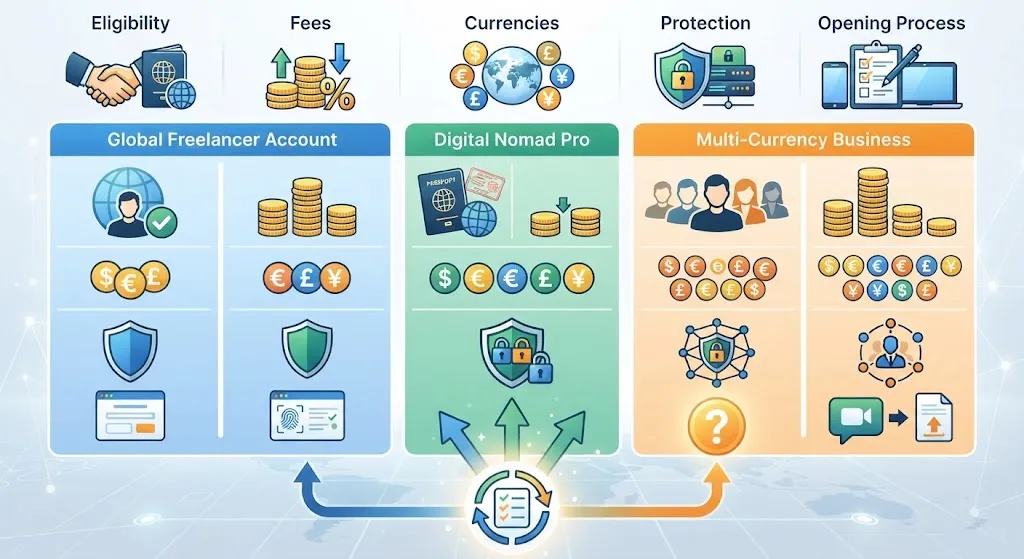
Online providers that serve customers across many countries are usually the fastest way to get started. They open the account online, often using a passport scan and a short video check, and they let you hold and receive several currencies. Availability depends on your country of residence, and some providers restrict certain countries or activities. For an overview of the products, see our guide to multi-currency accounts.
Best for: new arrivals, nomads and anyone who needs to receive international payments quickly.
Limits: they may not offer every local service, and they are not always full banks.
Option 2: A neobank or online bank in the country where you live
Some app-based banks open accounts for foreigners with fewer local documents than traditional banks. They may still require an address and, in some countries, a local tax number.
Option 3: Keep your account in your home country
If you already have an account at home, keep it, unless the bank asks you to close it because you moved. Tell your bank about your new country of residence, since failing to do so can lead to restrictions or closure later.
Option 4: A traditional bank in the country where you live
Local banks give you the full range of services, such as salary accounts, loans and mortgages, but they typically demand the most paperwork. Many require proof of a local address and a local tax number, and some require an in-person appointment.
Option 5: A bank in another country that welcomes non-residents
Some banks have specific non-resident accounts. These often come with minimum balances, higher fees, a requirement to visit in person or to have an existing relationship with the bank. For example, one bank’s non-resident account requires the customer to hold a savings account for at least six months and to pass a credit assessment. Treat this route as one for people with a real reason to bank in that country, such as property, business activity or family.
The documents you will be asked for
The exact list depends on the country and the bank, but guides from several countries show the same core set. A recent summary of what banks ask in one country boils the real document set down to identity, address, residence status, income, tax information and source of funds.
| Document | What it is for | Tips |
|---|---|---|
| Valid passport or ID | Confirms who you are | Make sure it is not close to expiry |
| Proof of address | Confirms where you live | Often must be recent, for example not older than three months, and sometimes translated |
| Tax identification number (TIN) | Used to report your tax residency | Some countries require a local tax number before you can open an account (for example, Portugal’s NIF) |
| Proof of income or occupation | Shows how you earn money | Employment contract, payslips, tax return or, if you are self-employed, invoices or business registration |
| Source of funds | Shows where the money you will deposit comes from | Recent bank statements, sometimes covering up to 12 months for non-residents |
| Tax residency self-certification | Declares where you are tax resident (CRS/FATCA forms) | Usually a form you sign |
| Local phone number | Used for verification | Required by some banks |
| Reason for the account | Explains why you need it | Be clear and honest |
Banks may also ask again later for updated proof of address or income to comply with anti-money-laundering and tax reporting rules.
Source of funds
For many foreign applicants, proof of source of funds is the most important extra requirement. A bank may accept your ID and address, but pause the application until it understands where your money comes from. Typical evidence for freelancers: invoices, contracts, bank statements showing client payments and tax returns. Keep your paperwork tidy. See how to invoice an international client so that your invoices show clearly who paid you and for what.
Tax residency forms
Banks are required to collect a self-certification of your tax residency and to report certain account information to tax authorities under international information-sharing rules. You will normally state the countries where you are tax resident and your tax identification number for each. Be accurate. If you are not sure where you are tax resident, read about tax residency for digital nomads and, for complex cases, consider an international tax adviser.
The proof-of-address problem
Proof of address is the quiet failure point of many non-resident applications. Banks typically want a utility bill, a bank statement, a rental contract or an official letter, dated within the last three months. If you have just arrived, that may not exist yet. Ways to deal with it:
- Use a document from your current or previous country if the bank accepts it, translated if needed.
- Ask the bank what alternatives it accepts, such as an employer letter, a rental contract, a registration certificate or a letter from another financial institution confirming your address.
- Register your address with local authorities as soon as you can, if the country requires it.
- Start with a digital account that accepts a wider range of documents, and open a local account once you have an address. This is a common route.
- Do not use a false or borrowed address. It is fraud, and it can get your account closed.
Step by step
- Decide what you need the account for: salary, rent, savings, international payments, a business, or a mix.
- Choose the option that fits, as described above. Many people end up with two accounts: a digital one now and a local one later.
- Check eligibility for your nationality and country of residence, and whether the provider serves non-residents.
- Ask what documents it needs and whether you can open the account online, by video call or only in person.
- Prepare your documents: ID, proof of address, tax number, proof of income and source of funds, with translations if required.
- Complete the application and the tax residency forms accurately.
- Respond quickly to any follow-up questions.
- Fund the account, starting with a small transfer if you are unsure, and keep the transfer receipt.
- Set up security: two-factor authentication, alerts and card controls.
- Open a backup account at a different provider.
A message you can adapt
If a bank does not publish clear requirements for non-residents, ask:
Subject: Non-resident account – requirements
Dear [Bank],
I live in [country] and would like to open a [personal/business] account with you. Please let me know:
- Whether you accept applications from non-residents of my country.
- Which documents you require (ID, proof of address, tax number, proof of income, source of funds).
- Whether the application can be completed online or needs an in-person visit.
- Any minimum balance, fees or other conditions.
Thank you for your help.
[Your name]
Business accounts
If you earn money through a company, or the bank requires business income to be separated, you may need a business account instead of a personal one. Non-resident business applications often ask for company registration documents, ownership details, a tax identification number and certified proof of address for each owner. See our guide to business accounts for freelancers working abroad for the options.
Check the protection
Before you deposit significant money, find out whether the provider is a bank or a payment institution and how your balance is protected. Our guide on how your money is protected explains the difference between deposit insurance and safeguarding.
Why applications get rejected
- Missing or outdated proof of address.
- No local tax number, where it is required.
- Documents that do not match, such as different spellings of your name.
- Unclear or unsupported source of funds.
- Applying from a country the provider does not serve.
- Incomplete tax residency forms.
- Unclear reason for the account, or a business activity that the provider does not accept.
- Previous account closures or compliance flags.
- Applying without the in-person step that the bank requires.
If you are rejected, ask whether you can fix the problem and reapply, and try a different type of provider.
After you open it
- Use it as intended. Business income belongs in a business account where required.
- Keep your details up to date. Tell the bank when you move or change tax residency.
- Keep some activity so that the account does not become dormant.
- Respond quickly to document requests.
- Keep your records.
Accounts can still be reviewed or closed after opening. Read why accounts get closed to avoid the most common causes.
Common mistakes to avoid
- Waiting until you need the account to start the process.
- Using a false address or documents that are not yours.
- Giving inconsistent information to different banks.
- Ignoring tax residency forms or filling them in carelessly.
- Moving all your money to one new account.
- Not reading the fees and minimum balances for non-resident accounts.
- Not telling your home bank that you have moved.
- Using a personal account for business income.
- Choosing a provider without checking how your money is protected.
Frequently asked questions
Can a non-resident open a bank account?
In many countries yes, but the requirements vary. Banks usually ask for ID, proof of address, tax information, proof of income and source of funds.
Do I need a local address to open an account?
Often yes for traditional banks, but some digital providers accept a wider range of documents or an address from another country.
Do I need a tax number?
Some countries require a local tax number to open an account, and banks always ask for your tax residency and your tax identification number for each country where you are resident.
Can I open an account without visiting the country?
Sometimes. Many digital providers work entirely online, while some banks require an in-person visit or a video call.
What is the easiest way to get started as a new arrival?
Many people open a digital multi-currency account first, then a local bank account when they have an address and the right documents.
Will my bank report my account to the tax authorities?
Banks collect tax residency information and, in many countries, report certain account details to tax authorities under international information-sharing rules. Always declare your income where you are tax resident.
Can a non-resident account be closed?
Yes. Providers can review or close accounts if your details are out of date, the account is not used as intended or compliance checks fail.
Final thoughts
Opening a bank account as a non-resident takes preparation, not luck. Know which situation you are in, choose the route that fits, gather your documents, explain your income clearly, fill in the tax forms accurately and start early. For many people, a digital account gets them started quickly, and a local bank account follows when the paperwork is in place. Whichever you choose, keep a backup and keep your information up to date.
This article is general information, not legal, tax or financial advice. Requirements change and vary by country and provider. Information reviewed October 6, 2026.
Sources and further reading
Official pages and primary sources where you can check the rules, fees and rates discussed in this guide. They are updated by their publishers, so check them for the current figures before you decide.
- Bank accounts in the EU, including the right to a basic account (Your Europe (European Union))
- The FATF Recommendations on anti-money laundering (Financial Action Task Force)
- Foreign Account Tax Compliance Act (FATCA) (IRS (US))
- Deposit guarantee schemes (European Commission)