What Is a Multi-Currency Account and How Does It Work?

General information, not advice. This guide explains how things usually work. Fees, rules and products change and depend on your country and situation, so check the provider's or authority's own page before you act. See our disclaimer.
Some links may be affiliate links. They never change what we recommend. How we make money.
If you earn in one currency and spend in another, or work with clients in several countries, you have probably heard that a multi-currency account can save you money. You may also have wondered what it actually is, how it differs from a normal bank account and whether it is safe to keep your income there.
This guide explains what a multi-currency account is, how it works step by step, what it costs, how your money is protected and who should (and should not) use one. If you are still learning how to collect payments from abroad, start with our guide on how to get paid by international clients and come back here to understand the account that makes it cheaper.
The short answer
A multi-currency account is an account that lets you hold, receive, send and convert money in several currencies from one place. Instead of having one balance in one currency, you have a separate balance for each currency you use, and for many of the main ones you also get local bank details, so a client can pay you as if you had a local account in their country.
What is a multi-currency account?
A multi-currency account keeps your money in several currencies within one app or login. You can hold balances, convert when the rate suits you and, in many cases, spend directly from whichever currency you need, without opening a separate account in every country you deal with. Unlike a traditional single-currency account, it lets you hold several currencies at the same time.
For example, one account could hold 1,500 US dollars, 1,000 euros and 800 pounds side by side.
How it works, step by step
1. You hold a separate balance for each currency
Each currency has its own balance. Money that arrives in dollars stays in dollars, and money that arrives in euros stays in euros, until you decide to convert it. Because the account does not automatically exchange incoming funds, you keep control of timing.
2. You get local account details
For many popular currencies, providers give you local-style bank details, such as a UK account number and sort code, a US routing number or a euro IBAN. Your clients can then pay you through domestic payment routes instead of expensive international wires, and the money arrives in your balance in the same currency. If you are paid in dollars, see how to receive US dollar payments without a US bank account.
3. You convert when it suits you
When you need another currency, you convert between your balances inside the account. A good account shows the exchange rate and the fee before you confirm. For a practical guide on keeping conversion costs low, see how to avoid hidden currency conversion fees.
4. You spend and send
Many accounts include a debit card that can spend in the currency you hold or convert at the point of sale, and let you send payments to other accounts in different currencies.
5. You withdraw to your bank
When you want the money in your local bank account, you transfer it. If the destination account is in the same currency as the balance you hold, there is usually no conversion, and the main costs are any withdrawal or transfer fees.
A simple example (illustration only)
Imagine a freelancer who works for a US client and a German client:
- The US client pays 1,500 USD by ACH to the freelancer’s USD details.
- The German client pays 1,000 EUR by SEPA transfer to the freelancer’s EUR details.
- The freelancer pays a 300 EUR coworking bill straight from the euro balance, with no conversion.
- At the end of the month, the freelancer converts 1,000 USD into local currency at a transparent rate and moves it to a local bank account.
At no point was money converted automatically at an unknown rate. The numbers are made up to illustrate the flow.
Who benefits from a multi-currency account?
- Freelancers and remote workers paid by clients in other countries.
- Digital nomads who spend in different currencies.
- Online business owners who sell to customers or pay suppliers abroad.
- Expats and international families who send money to or from another country.
- Frequent travellers who want to avoid poor exchange rates abroad.
If all your income and expenses are in one currency, a multi-currency account adds little and you may not need one.
Types of providers
The label “multi-currency account” covers several types of provider, with different features and, importantly, different protection:
| Type | What it is | Typical strengths | Watch out for |
|---|---|---|---|
| Banks | Traditional banks offering foreign currency accounts | Deposit protection, full banking services | Often higher fees and weaker exchange rates |
| Electronic money and payment institutions | Non-bank providers regulated to hold customer money | Low fees, local details in many currencies | Not a bank; usually no deposit protection scheme |
| Neobanks | App-based providers, some with banking licences and some without | Cards, budgeting tools, convenience | Features and protection depend on the entity and country |
| Payout platforms | Providers built for marketplaces and agencies | Widely accepted for marketplace payouts | Conversion and withdrawal fees |
For a head-to-head look at the best-known options, see PayPal, Wise or Payoneer.
Not the same as a bank account
A multi-currency account works in a way similar to a standard bank account, but it is not always one. In some countries, the same term is used for two different products: a bank deposit and a payment balance held with a licensed payment or e-money provider. They look similar in the app but are protected differently. A multi-currency account from a non-bank provider can complement a traditional bank account, but it does not fully replace one, because these providers do not offer certain regulated banking services such as lending or deposit protection schemes. If you want to compare the trade-offs, read neobank vs traditional bank for expats.
What it costs
Fees vary a lot between providers, so look at all of these:
- Opening and monthly fees. Many have no monthly fee, but some charge a one-time fee to unlock local details.
- Receiving fees. Often free for local payments, with a fixed fee for some wires.
- Conversion costs. The exchange rate margin plus any fee. A good provider uses the mid-market rate and shows its fee separately.
- Sending and withdrawal fees.
- Card and ATM fees.
- Fees for extra services, such as higher limits or additional cards.
Compare the total cost on a typical payment using our transfer fee calculator rather than relying on headline fees.
Is your money safe?
How your money is protected depends on the type of provider, so this is one of the most important things to check.
- Banks. Money held with a licensed bank is covered by a deposit protection scheme in many countries. In the UK, for example, the Financial Services Compensation Scheme protects eligible deposits up to £120,000 per person, per institution (check the current limit on the FSCS website). In the US, the FDIC insures deposits at insured banks, and it only covers money held in a deposit account at an FDIC-insured bank. Limits and rules differ by country.
- Non-bank providers. Electronic money and payment institutions usually use safeguarding rules, which require them to keep customer money separate from their own funds with a trusted bank or financial institution. Safeguarding is a different mechanism from deposit insurance. It means the money is ring-fenced if the provider fails, but it is a contractual protection and not a statutory guarantee, and repayment may not be instant.
- Providers with a banking licence may offer deposit protection on balances held at the bank entity. Reviews in 2026 report that some neobanks have obtained banking licences in certain countries, which can change the protection, so check which entity holds your money.
A well-known example: UK guides in 2026 consistently describe Wise as a regulated electronic money institution whose balances are safeguarded but not covered by the FSCS. Keep in mind that these arrangements can change, so confirm the current position on the provider’s own site and your regulator’s register. For more detail, see whether multi-currency accounts are safe.
A sensible approach is to keep the money you need for day-to-day operations in the account, and your emergency fund and larger savings in a regulated bank with deposit protection.
Pros and cons
Pros
- Receive payments like a local in several currencies.
- Avoid forced conversion at a bad rate on arrival.
- Convert when the rate suits you, or hold currency for expenses in that currency.
- Often lower fees than traditional banks for international payments.
- One place to manage several currencies.
Cons
- Currency risk: because the balance is not automatically converted, its value in your home currency can go up or down.
- Not always a bank, so deposit protection may not apply.
- Limits, verification requirements and availability depend on your country.
- No lending, overdrafts or other full banking services in many cases.
- Accounts can be reviewed or restricted while the provider carries out checks.
Sending money out
A multi-currency account also makes it easier to pay suppliers or send money to family abroad, because you can pay from the currency you already hold. The cost still depends on the route, so compare options first. Our guide to the cheapest ways to send money abroad shows how to spot a hidden margin.
How to choose one
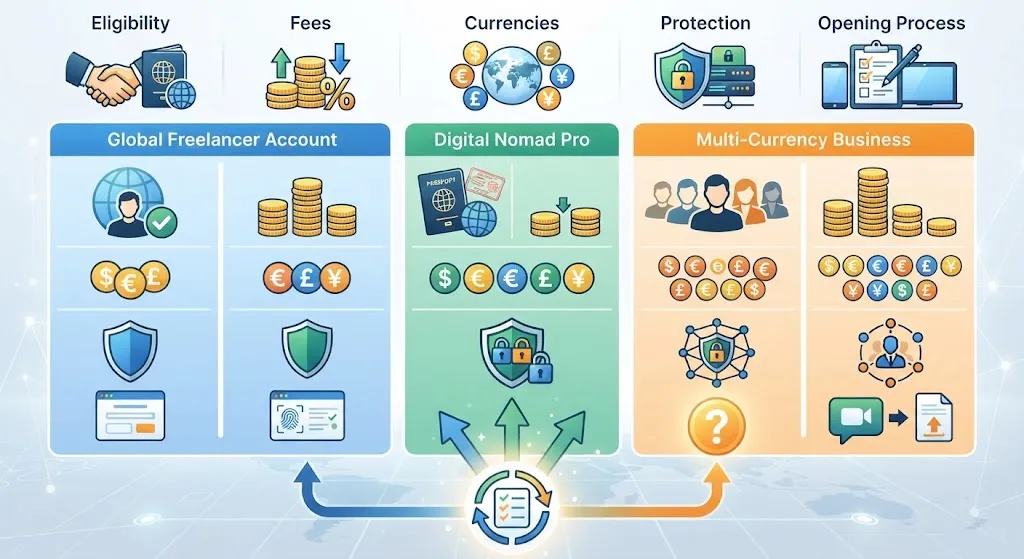
Look at the same points for every provider:
- Which currencies have local account details in your name and country.
- Conversion cost, compared with the mid-market rate.
- Receiving and withdrawal fees.
- Protection: whether it is a bank or an e-money institution, and what safeguards apply.
- Verification and limits, including how fast you can open it.
- Card and ATM costs, if you will spend abroad.
- Support and reliability.
For a comparison of specific options, see our guide to the best multi-currency accounts for freelancers and nomads.
How to open one
- Check availability for your country of residence and the currencies you need.
- Prepare your documents: ID, proof of address and, for business accounts, company details. If you live somewhere other than your home country, see how to open a bank account as a non-resident.
- Complete verification and turn on security features such as two-factor authentication.
- Request local details for the currencies your clients use.
- Test with a small payment before your first large invoice.
- Open a backup account at a different provider.
Common mistakes to avoid
- Treating it like a bank account with deposit protection when it is not one.
- Keeping all your savings in one provider.
- Letting the account convert automatically at a poor rate.
- Ignoring currency risk on balances you hold for a long time.
- Not checking limits and verification requirements before you need the money.
- Waiting until you need it to open the account.
- Depending on a single account for all your income.
- Mixing personal and business money.
Frequently asked questions
What is a multi-currency account?
An account that lets you hold, receive, send and convert several currencies from one place, often with local bank details for each main currency.
Is a multi-currency account the same as a bank account?
Not always. Some are bank deposits, others are payment balances held with licensed payment or e-money providers. Protection differs between the two.
Is my money safe in a multi-currency account?
It depends on the provider. Banks usually have deposit protection in many countries, while non-bank providers usually safeguard customer funds in separate accounts, which is a different kind of protection. Check the details.
Do I pay to hold several currencies?
Many providers do not charge a monthly fee for holding balances, but some charge a one-time setup fee for local details, and you pay conversion and transfer fees.
Can I get local account details in any currency?
No. Providers offer them for a limited set of currencies, and availability depends on your country.
Do I need a multi-currency account if I only have clients in one country?
Probably not, unless you spend or travel in other currencies.
Can it replace my normal bank account?
For most people it works best alongside a regular bank account, not instead of it.
Final thoughts
A multi-currency account is a practical tool for anyone who earns or spends in more than one currency. It lets you get paid like a local, hold money in the currency you receive and convert on your terms. Choose a provider that matches the currencies you use, check how your money is protected, keep your savings in a regulated bank and open a second account as a backup.
This article is general information, not financial, tax or legal advice. Features, fees and protection change and vary by country. Information reviewed October 5, 2026.
Sources and further reading
Official pages and primary sources where you can check the rules, fees and rates discussed in this guide. They are updated by their publishers, so check them for the current figures before you decide.
- Wise pricing and fees (Wise)
- Payoneer pricing (Payoneer)
- Deposit guarantee schemes (European Commission)
- Payment services in the EU (PSD2) (European Commission)